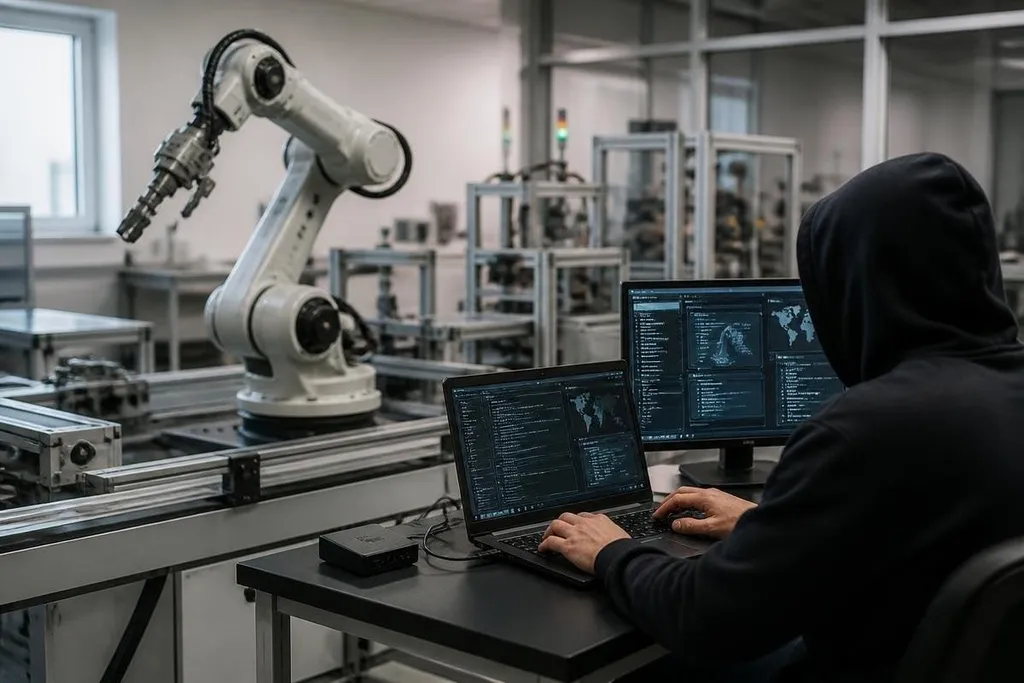
A robot can receive commands through a network, a service port, a remote-control station, or software used by its operator. If an attacker reaches that command path and passes its checks, the robot may move, stop, reveal sensor data, or accept a new task.
For anyone buying or running an industrial robot, the useful question is not whether robots can be hacked. It is which commands are exposed, which checks protect them, and what the robot does when the network fails.
Quick read
- Network access can expose movement commands, cameras, maps, and task data.
- A stolen password may be enough when control software lacks another identity check.
- Physical safety systems should still stop dangerous motion when software behaves badly.
How control can be lost
Robots rarely act alone. A mobile robot may receive a route from a control server, while a factory arm may take jobs from a production system.
An autonomous vehicle may send camera or LiDAR data to another computer for analysis. Each connection adds a place where an attacker could try to enter.
The attack path can begin with an operator account, a poorly protected remote service, a laptop connected to the robot network, or software supplied by another company. From there, the attacker may seek command access rather than direct motor control.
Changing a job, blocking a route, or sending false sensor data can still change what the robot does. A service account that can read status data has a smaller reach than one that can send motion commands, change speed limits, or update software.
Separating those rights makes a stolen login less useful.
What an attacker could do
The result depends on the robot, its software, and its safety design. An attacker may stop work by cancelling tasks or cutting the robot's connection to its scheduler, change movement by sending a new route, pose, speed, or destination, or steal data from cameras, maps, microphones, logs, or production systems.
Status messages and useful records may also be changed or deleted, hiding faults from the operator. Equipment could be damaged if software commands can reach motion systems without another check.
These actions don't require a movie-style takeover. A delivery robot that refuses to move can create a serious operating problem, while a camera feed can expose a site, a worker, or a product without any motor moving at all.
A connected robot can expose more than its motor controls. Wireless links, remote update tools, and cloud services may give an attacker a path to cameras, task settings, or movement commands, depending on how the maker built the system. Robot24.com's robotics reporting can help you compare those claims with named machines, security tests, and the limits of remote access. I'd treat any claim of full control as unproven until someone shows the test.
The limits of remote control
A network breach does not always give an attacker complete control. The robot may reject commands outside a safe range, require a local approval, or lose its connection before a task starts.
A separate emergency-stop circuit can remove power from motion systems even when the main computer is compromised. That protection has limits: an emergency stop may halt movement but cannot erase copied data.
It may also leave a vehicle blocking a route or an arm holding a part. Safety hardware reduces harm; it doesn't repair a weak account system or a badly exposed server.
The open question for each deployment is what the robot can do after its normal command source is no longer trustworthy. A design that keeps moving with old instructions may need a different response from one that stops and waits for a local operator.
Checks before a robot goes online
Use this short review before connecting a robot to a plant, office, or public network:
- List command paths: write down every system that can send tasks, change settings, or update code.
- Limit each account: give operators, service staff, and software only the access their jobs need.
- Separate networks: keep robot traffic apart from ordinary office devices where the design allows it.
- Test the stop state: confirm what happens when the server, wireless link, or sensor feed drops.
- Keep records: log command changes, account use, software updates, and safety-stop events.
- Plan local control: make sure a trained person can stop and inspect the robot without the remote service.
I'd treat any robot with remote motion commands as a connected machine first and an autonomous system second. That view leads to plain checks: protect the command path, reduce permissions, and prove the safe response before a real task begins.
The machine doesn't need to move dangerously for a breach to matter. The safer design is the one that can lose its network, reject bad commands, and still leave people with a clear way to stop it.